Across the Mississippi

image

Trees.  Woods.  Forests!  I’m leaving the plains behind as I continue East, welcomed by old, familiar, “Eastern” birds such as Blue Jays, Scarlet Tanagers and Wood Thrush.  Since I crossed the Cascades more than a month ago, the background sound-track for my ride has been the melodic song of the Western Meadowlark, day-in-day-out.  So it was a milestone the other day when that melody was replaced by the very different music of the Eastern Meadowlark.  O.K., you have to be a bird nerd like me to appreciate this point, but it signals a significant shift similar to the 100th meridian that I mentioned a week ago.


I arrived in Enderlin, North Dakota, just in time for its 125th anniversary weekend.  Terry at the Traxside Cafe said, “Oh, you’ve got to come to the musical tonight.  We’re doing Music Man.”  And what a treat of Americana it was, seventy-six trombones and all, performed by an astonishing cast from four-year-olds to eighty-four-year-olds.  This town has talent, and involves its youth, which is a good thing.  ‘Til there was you brought tears to my eyes and brought down the house.

image


As I was approaching downtown Fargo the next day, I stopped at a street corner where some kids were selling lemonade.  “Seventy-five cents for lemonade,” they informed me, “and one dollar for a poem.”  Well of course I had to get both, and spent half-an-hour there talking with the kids about my bike and why I was going all the way across the country, and with Erika Dyk, the poet.  Here is my dollar’s worth:

image


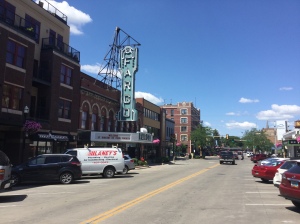
In the big city of Fargo, Aw geeze, they really do speak with an accent!  I happened to cross paths with an old Seattle friend, Alan Johnson, who was on his way driving to his fishing lodge on Lake of the Woods, and we had a good evening tasting local ales and catching up with each other.
image

image


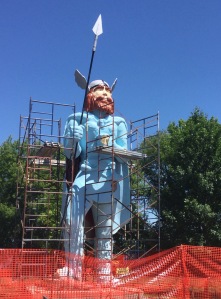
Just across the Red River in Moorhead, Minnesota, is the Hjemkomst Center.  There was a Scandanavian festival going on (what a surprise) with lots of would-be Vikings dressed in funny helmets.  The replica of a Viking ship in the museum was cool — it brought me back 40 years to Mary Sue’s and my visit to the similar museum (with an original, excavated ship) in Oslo, Norway.

image


The scenery changed quickly once I was a few miles into Minnesota.  Goodbye flat plains, hello woods and rolling hills.  And lakes.  O.M.G. There are a lot of lakes everywhere, around every turn of the road. I guess I should have expected that in the state of 10,000 lakes, yet the change in topography from the flat farmland of Montana and North Dakota still surprised me.

image

image


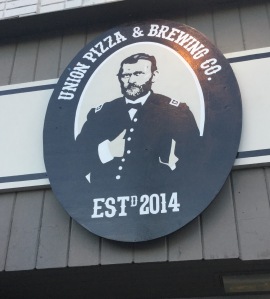
After a hard, 85-mile day over rolling hills and headwinds, I arrived at the Union Pizza & Brewery Co. in Fergus Falls, MN.  The owners, Ben and Tessa Schierer, just opened the brewery a year-and-a-half ago and its fame already precedes it along the bicycling route.  Tessa found me a seat at the bar and I got talking to the couple sitting next to me who live in “the cities” (Minneapolis/St. Paul) but have a farm in nearby Pelican Rapids.  As I closed the place down and went to settle my bill, Tianna, the bar tender, indicated with a smile that my tab had already been paid by the folks I’d been talking with.  Road angels continue across this great land.
image


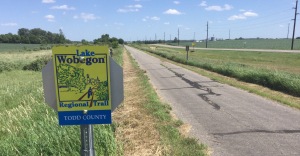
I peddled for a day and a half away from all the traffic on some fabulous, long, flat bike trails converted from old railroad rights-of-way.  Part of the network is known as the Lake Wobegone Trail.  Definitely above average,.
image


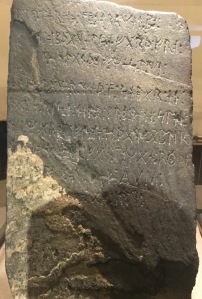
I stumbled upon an interesting artifact in Alexandria, MN — the Rune Stone — which bolsters a Scandanavian-origin story for this part of the country.  If real, this stone documents a visit by Nordic adventurers in 1362 via Hudson Bay, 130 years before Columbus.  Debate continues as to whether this is one of the most significant archeological finds in North America or a well-crafted hoax.  The nearby “Big Ole” statue commemorates the area as the “birthplace of America.”
image

image


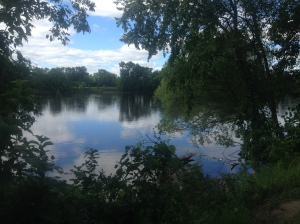
And then, boom, I crossed the Mississippi River almost before I realized I was doing so. It is a good-sized river in this area north of St. Cloud, but not yet the giant it turns into farther south.  I was about 100 miles from its source at Lake Itasca.  This bridge is another huge milestone on my journey East.
image


In the Half Moon bar in Stark, MN (population 98), the motorcyclist sitting next to me nearly fell off his barstool when I mentioned that I crossed over the mighty river at Bowlus. “That’s my hometown,” he said, “and most people even here in Minnesota don’t know where it is.”  When I called up a photo on my iPad of the nice cafe I had eaten lunch at in Bowlus, he almost fell off again.  (This had nothing to do with the good ales we were drinking.) “My grandfather built that building!”, he exclaimed.  He bought a round and kept shaking his head that a guy on a bicycle from Seattle knew his home town better than most locals. I love these small-world moments.

image


Corn has becomes the dominant crop.  It is already more than knee-high before the Fourth of July around here, which bodes well for a good harvest.  Many of these fields are being irrigated since it hasn’t rained enough lately around here.

image

Which reminds me of an amazing statistic of my trip so far:  I have gone for more than a month (35 days) of dry peddling!  I’ve had some rip-roaring thunderstorms at night, but it has been since Sand Point, Idaho, since I’ve ridden in the rain!  Cricket of Whitefish exclaimed, “Dave, you are a charmed man,” upon learning that to that date I had only had a half-day of headwinds.  Well, the wind charm didn’t last east of the Rockies, but the rain thing feels like Camelot.


I have been resting the last few days in Hugo, MN, just north of St. Paul, visiting our college friend, Elizabeth “Binkie” Closmore and her husband, Greg. I got nice comments along the final miles of bike trail for the flowers I brought for my hosts.

image

image


And so, brave, courageous or charmed, I head NE into Wisconsin and over the. U.P. of Michigan.  Me and the mosquitos, I fear, but it is a section of the north country I’ve always wanted to visit.

I think I’m about half-way!

image

Happy and safe Fourth, everyone.

— Dave (posted 6/30/2016 from Balsam Lake, Wisconsin)
 

Zen and the Art of Long-Distance Bicycling

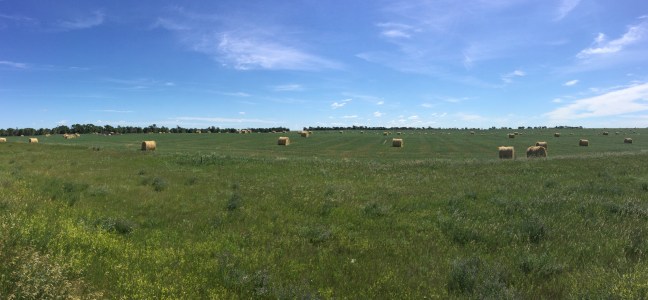
The Cenex store in Hazelton, North Dakota, was full of baling twine the other day and conversations about repairing bailing machines.  ‘Tis the season, as the first crop of hay is ready in thousands of acres of nearby fields.  The expression, “Make hay while the sun shines,” rings true to its origins out here on the prairie in June: no time to waste when the grass is cut and the sun is baking it dry, with thunderheads threatening.image

My trip across this stretch of country is governed by an adaptation of the hay adage: “Make miles while the tail-wind blows.”  The winds can change dramatically from day to day as the high and low pressure systems drift across the land.  I check my weather and radar apps daily in order to assess whether I’ll have an easy day or a handlebar-gripping workout, and I plan my mileage goals accordingly.

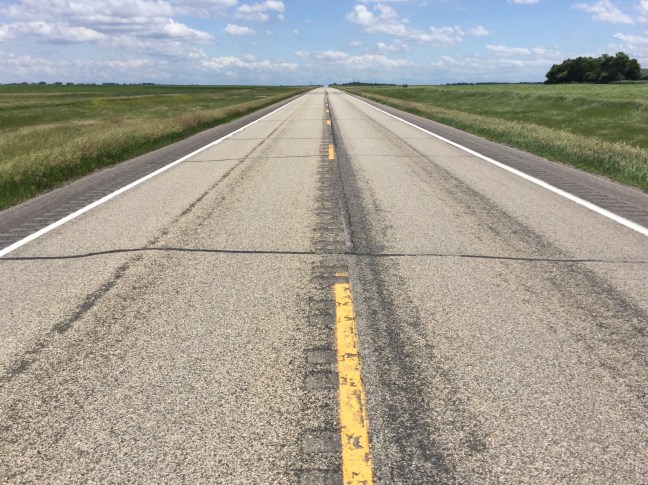
Today was one of those amazing convergences when everything came together: a truly Zen moment on the bicycle.  I had a 20 mph tail-wind all day; a road (ND 46) that is said to be the longest stretch of arrow-straight highway in the U.S.; my legs moving in cadence like a well-oiled machine while riding on a well-oiled machine; and nothing to clog the mind except to contemplate the infinity point where the road meets the horizon in front of me.  Bicycle meditation at its best.  image

Of course, meditation is all about being in the moment and letting distractions fade away.  While riding my bike, it is NOT about daydreaming or drifting off — it is really about focusing on the road directly in front of me, taking in the scene on either side, and always listening and checking the rear-view mirror for the next 18-wheeler (or any vehicle for that matter) that is coming up behind me.  Safety first!  When in this moment, pretty much everything else is out-of-mind, and I go for hours, pistons firing on all cylinders and peddles turning to the rhythm of my knees pumping up and down almost effortlessly.  I love this ride.

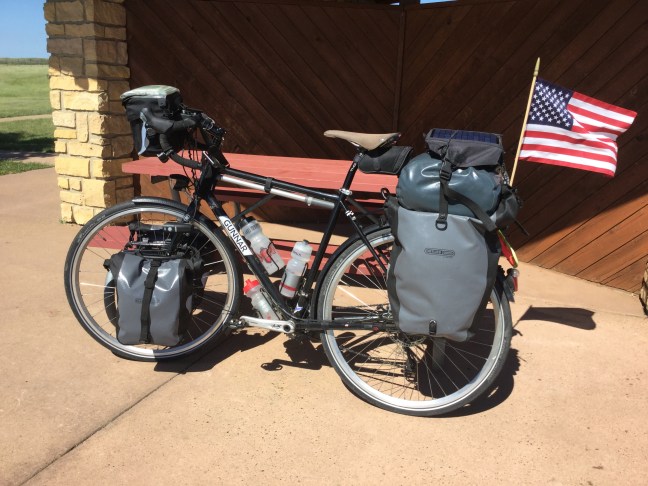
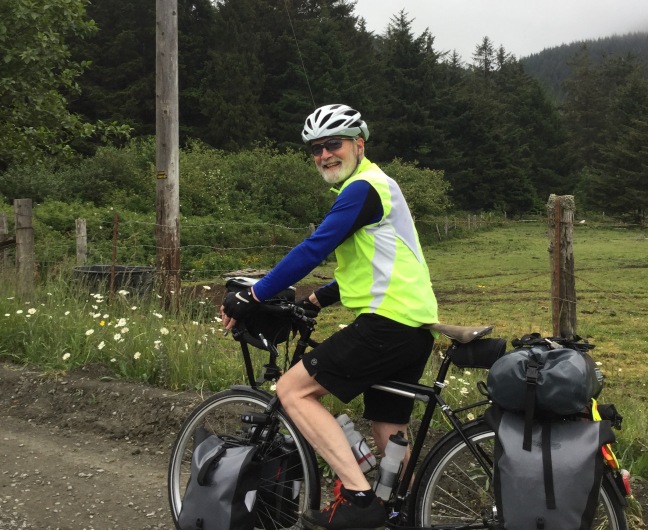
Speaking of well-oiled machines.  First, my bike is performing flawlessly.  It flows across the miles, and has not had a single issue to date.  I clean and lubricate the chain periodically, but otherwise trust this machine to perform.  It might be like talking about a no-hitter  going into the ninth inning, but check out the final statistic in my “Progress” list after 2000 miles.  Gotta love those Schwalbe Marathon tires.image

(I know I’m into a stiff wind when Old Glory is out straight while I’m stopped!)

And second, the aging body is doing remarkably well.  My butt still gets sore after 80 miles on the saddle, but it’s ready to roll again the next day.  (In the long run, my mom was probably right.)  I’m lathering on the sunscreen yet am turning brown as a nut with a classic “biker’s” tan.  I notice that my bike shorts are getting loose, and I don’t think it’s the shorts.  I’m burning 4000 to 5000 calories a day, and, you know?, it’s hard to eat that much day-in-day-out!  I expect that I’m getting meaner as well as leaner.


I didn’t realize until the other day that I’m passing through the “German Russian Triangle” in this part of North Dakota.  In Napoleon ND I spent a couple hours the other morning at the only cafe talking to a table full of locals, whose average age was over 90.  They all spoke with German accents although they were all born within 50 miles.  A large group of “Volga Germans” (originally recruited from Germany by Catherine the Great to settle in Russia, but later experienced repression there) emigrated to North America in the late 1800s and settled in this area, bringing their German language and traditions with them.  This group in the Napoleon cafe was a hoot: very friendly, inquisitive about my trip and my life, and full of vim and vigor.  They all looked like apple dolls, their weathered faces having spent 9 decades farming the land.  One of the 90+-year-old women patted my shoulder on her way out of the diner and said,”Be careful out there.  But if not, name it after me,” with a wink.  One of the other women left with a parting goodbye:  “Mach’s gut.”  Her husband translated:  “Make it good.”  I love these small towns.


So carefully I proceed, meditating when the conditions are right and keeping a relentless focus on East.  I’ll get to Fargo tomorrow.  Four states down, twelve to go.


— Dave (posted on 6/22/2016 from Enderlin, North Dakota, which is celebrating its 125th anniversary this weekend)


Across the 100th Meridian: Goodbye West, Hello Heartland

I crossed the 100th Meridian today, a milestone on this journey after almost 1900 miles of peddling.  I’m leaving the West behind as I move ever eastward.  While the changes in landscape are not as dramatic as when I crossed over the Rockies, they are here nonetheless:  more varied terrain, more trees, different and more varied crops, the beginnings of endless fields of corn, and birds that I think of as “eastern” varieties such as Baltimore Orioles, Chimney Swifts and Field Sparrows.  Farms are looking more prosperous, and I begin to notice ethanol plants replacing the huge grain silos of the dryland wheat region.image

(Still wide open, still long, straight roads, but a changing landscape nonetheless as I move east; photo east of Bismarck, North Dakota.)

These changes are what this trip is all about, eh?  It is one big continent to cross, and the variety of terrain, weather, rainfall, farmland and settlements is what makes this country so interesting and gives regions their character.  At an average pace of 10 miles per hour, I’m trying to take it all in.


Did I mention THE WIND?  Not since the slopes of Mount Rainier have I experienced winds like here on the high plains.  My daily life now depends on how the wind blows.  A tailwind is a total blessing — I can make 80+ miles while being blown across the great flat spaces.  Sidewinds and, even worse, headwinds, can change the equation dramatically.  Coming out of Medora ND recently, I had such a nasty headwind that I was peddling downhill to get any forward movement, and I was down to my lowest mountain gear on the flats and uphill in order to garner more than 5 miles per hour.  A workout, indeed.

Today a local in his pickup confirmed the obvious to this visitor: “Yep, it’s a rare day around here when the wind don’t blow one direction or another.”

Many of you have commented that traveling west to east such as I am doing should be all tailwinds.  The reality is anything but.  Sure the general weather moves west to east.  But the wind responds to the high and low pressure areas (highs rotate in a clockwise direction, while lows go counter-clockwise).  Thus, as high and low systems move across the landscape, the winds change, often quite dramatically within 24 hours  Terrain features (buttes, river drainages) also affect the direction of wind on a local level.

I love (especially while enjoying a tailwind) to watch the whole prairie seem to move across the landscape.  The surface of the land seems to be alive, and moving, as the wind tickles each grass head in turn.  Take a look at this short video (I hope it plays for you) to get a sense of how the whole prairie seems to flow like a river.  I can enjoy this view if I’m going with the flow, but it is a teeth-clenching, swear-word-uttering workout to go against it on two non-motorized wheels.


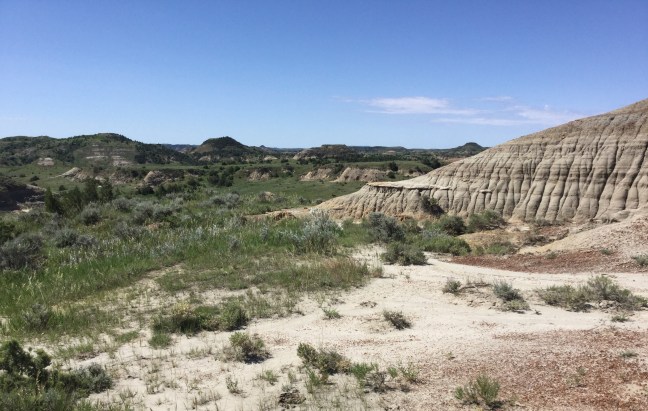
As I moved from the high prairie of Eastern Montana across the state line into North Dakota, the terrain changed dramatically:  from rolling high plains to the Badlands.image

What a cool place.  I’m a big fan of Teddy Roosevelt, who spent some formative years here (a great read:  McCullough’s Mornings on Horseback).  So I’ve always wanted to check out this area that he said formed his character (as huge as that was).image

The reality matches the hype.  I can see why Teddy loved this place.  As I took a “rest” day (only 36 miles of steeply rolling terrain) riding through the southern unit of Theodore Roosevelt National Park, the vistas were fabulous of layered sandstones, hoodoos and canyons — this is very different topography from nearby Montana.  I saw prairie dogs, bison and wild horses (and couldn’t drag Mick Jagger’s voice away for the next few days from the song loop going around in my head).  It is a unique place.image


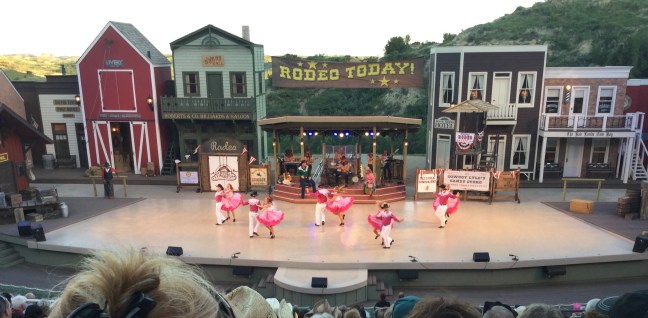
In Medora ND, an oasis where the salads are actually Romain instead of the ubiquitous iceberg and the beer selection includes Beaver Creek IPA as well as Bud Light, I took in the locally famous Medora Musical.  This incredible production, now in its 51st year, is set in an outdoor amphitheater rivaling the Gorge in George, WA, for its dramatic setting.  The country-western song and dance numbers, coupled with celebration of local cowboy history and a huge dash of Americana patriotism, are delivered with Broadway-quality voices and choreography.  It is quite a production and it spoke to me of Dakota values, a love of the land and local history, and a deep-rooted patriotism that is not usually on display where I come from, all red-white-and-blue and God Bless America.  Two enormous elk appeared on the ridge across from the theater as if on que, their huge antlers glowing in the setting sun.  Quite the scene, indeed.  I’m in the Heartland, fer sure.image


I crossed the Missouri one last time at Bismarck, the capitol of North Dakota.   It was nice to be in the area where Lewis and Clark spent their first winter in 1804 near the Mandan Villages just north of my trajectory.  (Another great read:  Stephen Ambrose’s Undaunted Courage.)  The Missouri is one impressively big river at this point.image


And so I continue ever eastward in search of America.  I’m making progress, yet still have a ways to go…image


— Dave (posted from Napoleon, North Dakota, on June 20, 2016)

Big Sky …and Big Wind: Eastern Montana

I have discovered a new appreciation for the word VAST.  It describes Eastern  Montana, both the land and the sky. And the distances: I have spent more than a week of extended mileage heading east, yet the state goes on and on!  This is one BIG place.

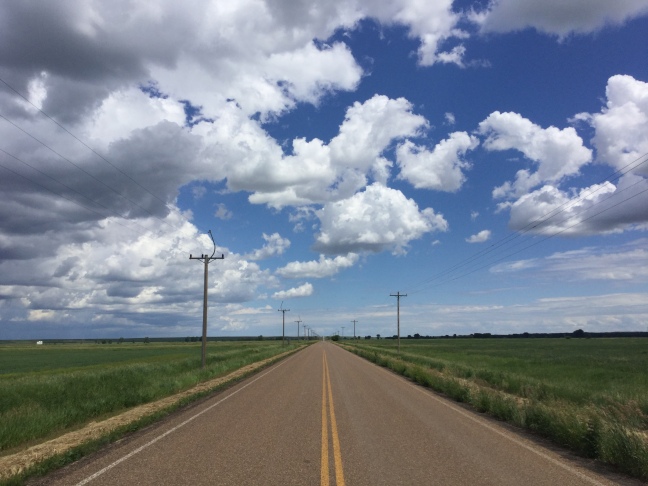
As I descended from Marias Pass over the Rockies, it was as if a switch was turned: no more trees, wide-open landscape, a whole new, open world out in front of me.  What an awesome place!  I feel like a land mariner on a huge open sea:  the gentle swells of land rise and fall, with views left, right, center and behind as far as the eye can see.image

(Note how straight Highway 2 is in what is called the “North Line” acr0ss E. Montana)


The difference from the mountains and trees of my first three weeks is stark.  The high plains are rolling and remote.  Yet populated by resilient and friendly folk.  My first campsite in East Glacier MT was a result of a recommendation from the woman running a tiny cafe west of Marias Pass; she made coffee for me in the morning before I continued east.  When I pulled into Hinsdale MT, a local suggested we (me and two other cyclists) stay in the basement of the Lutheran church in order to avoid the mosquitoes and gnats; she insisted on cooking breakfast for us the next morning.  Road Angels are everywhere!  The kindness of strangers is wonderful.

First, I put the Rockies in the rear-view mirror and focused on heading east.image

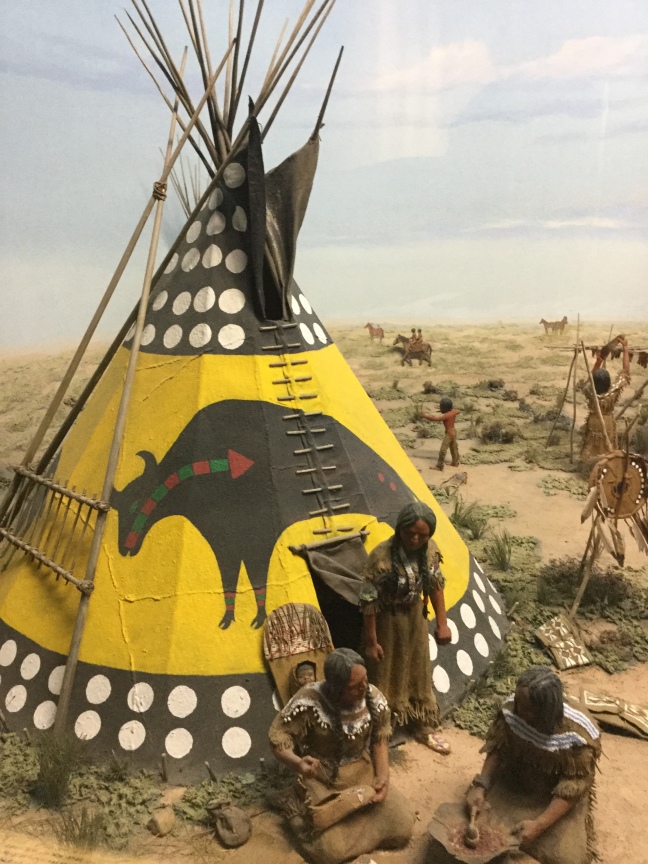
This is Indian country, in a big way, with many large reservations.  First I crossed the Blackfeet Indian Rez, on the east side of the Rockies, including a stop at the neat little Museum of the Plains Indians in Browning.  Later I’ve crossed and/or stayed in the Fort Belknap and Fort Peck reservations.  These areas are home to the Blackfeet, Assiniboine, Gros Ventre and Siouxe tribes.  Just this morning I was talking with a local in Wolf Point; when I told him I started in the Macah reservation at Neah Bay, WA, he was instantly more friendly, and assured me that now that I was in “Siouxe country,” all would be fine.image

(A diorama from the Museum of the Plains Indians in Browning MT)


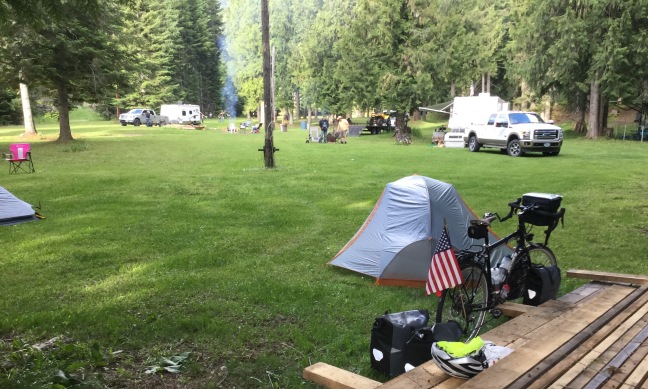
In the tiny town of Hingham MT (population 118), I stayed in the town park, on a Friday night.  As luck would have it, a local grain company was hosting a burgers-and-beers night at the park for the area farmers.  They invited me in: free burgers and beer, and a chance to chat with the locals.  Nice people, all.image  They were incredulous of my trip, and talked reverently of the local land and its history, since to a person they had been born in the town or grew up within 50 miles.  Weather is always a big  conversation item among farmers, and here was no exception.  When I mentioned that the Two Medicine area near where I camped in East Glacier got an inch of hail the night before, it was clear that I had used a four-letter word:  to a person, conversation ceased momentarily as all the farmers thumbed their cell phones checking their weather radar apps as we hunkered under the picnic shelter with the latest thunderstorm raging outside.  They told stories of losing more than $100K of crops just last Fourth of July because of hail.  Definitely a concern among these folks.
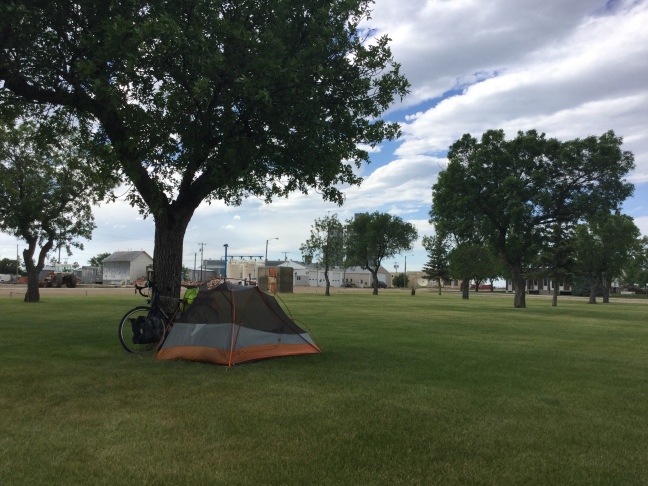
The locals lamented the slow demise of these small farming towns along the “North Line” (the towns spread east-to-west along the old Great Northern railroad line as well as U.S. 2 highway).image

(My campsite in the park at Hingham, MT, which used to be ringed by vibrant businesses.)

Locals my age talked about being part of graduating classes of 50 in the town’s high school; today there is one high school for four towns, and this year’s class has 13 students.  The farmers acknowledged that the the trend is driven by economic factors:  they now farm three- and four-times the acreage per family, and require fewer workers to do so because of increases in technology, thus there are fewer jobs to hold onto the kids who grow up here.  The community is still close, and the hometown values clear.  It was really fun to spend an evening with them — it renewed my sense that we Americans are far more similar than different.
In Havre MT (pronounced “Have ‘er”), I came across a “Buffalo Jump” — an incredible archeological site where Native Americans for thousands of years lured buffalo over the bluffs to their death within a small area.  The ground is full of millions of buffalo bones in layers feet thick.image.jpeg

(Buffalo bones feet thick in the area of a “jump” where natives lured the animals over a steep bluff by the Milk River, Havre, MT.)

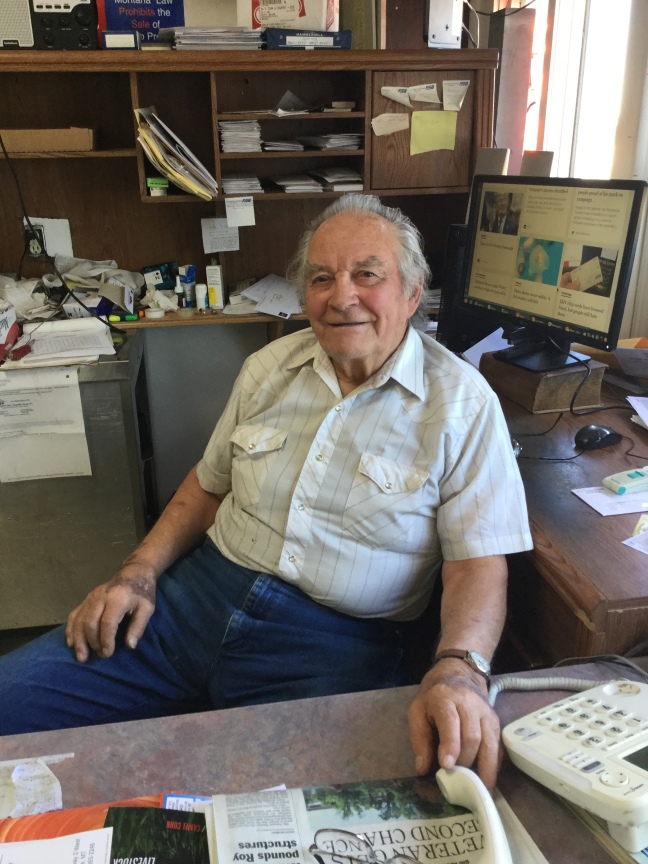
In the tiny town of Dodson MT (population 124), I met Al Minugh in the only “cafe” there.  He started some coffee for me, then we spent two hours talking about his life, including many years in Seattle working on radio towers.  He set up the high towers on Queen Anne Hill and fixed lights on the spike atop the Space Needle.  He was locally famous in 1962 when he helped the University of Washington take down a prank flag from UBC by shinnying up the 90-foot tall flag pole on campus; his photo was on the  front page of the Seattle P.I., which he proudly showed me a copy of.  What a treat to find this guy out in the middle of the wheat fields with stories to tell about Seattle in the 1960s.image.jpeg

(Al Minugh in Dodson MT — famous as a flag-pole climber in Seattle in the 1960s.)


The wide open farmland of Eastern Montana continues relentlessly as I peddle east: high plains dry-land wheat, then peas and lentils, and lots of range land.image.jpeg

As well as lots off straight-as-an-arrow roads to ride down the middle of.  Amazing country that seems to go on-and-on without end!

I met a great couple from Salem, Oregon, who are cycling the same route: Sherry Therens and Cindy Flugum.  It has been fun to get to know them as we cycle together off and on over the past few days.  They hope to finish in Maine sometime in the fall.image

(Sherry and Cindy, my cycling mates for a few days in Eastern Montana.)


I’ll close with a perspective shot.  I’ve been posting daily map updates on the “Where’s Dave?” page, focused as much as I can on the states involved.  Here is my first post of the progress to date for the whole continent.  I’ve traveled just over 1500 miles as of today, and the experience so far has been fantastic.  I have a long way left to go!image


Thanks for all your continued interest and support for my trip.  I love hearing from you.  Onward I go into North Dakota within a few days, and ever eastward.

— Dave (posted June 14, 2016)


Chilling in Whitefish, Montana

I know I’m no longer in the Pacific Northwest when I see “Elk Meatloaf” and “Bison Burgers” as regular  items on the menus.

Coming into Whitefish, I found myself humming “America, the beautiful” as I looked at the purple mountain majesties in front of me and stretching for hundreds of miles north to south.  The Rockies are a truly inspiring range, no doubt about it.image

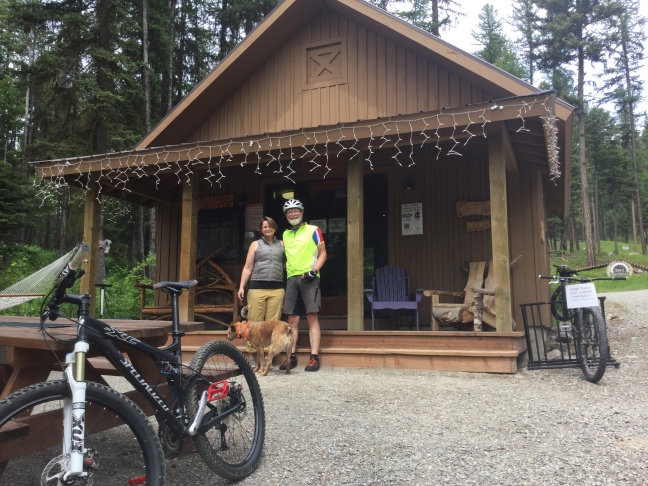
I arrived via the Stillwater Valley into the edge of Whitefish, Montana, on Tuesday, May 31st (Nick’s birthday, happy #28, my son!).  I peddled up a gravel side-road to a little oasis in the forest: the Whitefish Bike Retreat.  This is a spot geared for mountain bikers, connected directly to the world-class and world-famous Whitefish Trail, with a lodge and nice camping accommodations, including Yaak Attack ale on tap in the “office.”  Cricket Butler is the face of this place, a pleasant former geologist who lives and breaths mountain biking.  I highly recommend a stay here if you are anywhere near Whitefish.image

(Ya gotta love a host named Cricket at the Whitefish Bike Retreat, 6/1/2016)

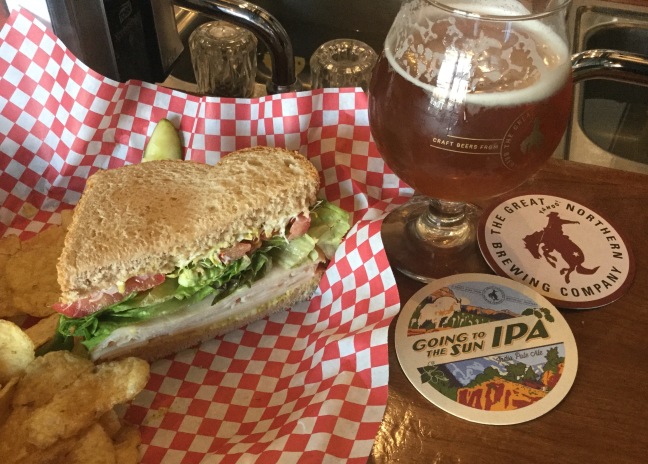
The other day I stopped to talk with a couple of young cyclists, Libby and Joey, who were circumnavigating Koocanusa Lake over Memorial Day weekend.  They recommended that I stop at the Great Northern Brewing Company’s brewpub in Whitefish, one of the classic, two-story, shiny-copper breweries in the Belgian style.  So I did, and I wasn’t disappointed: nice set up, nice people, tasty IPAs, including Going to the Sun and Bluebird Day Double.  Worth a stop, indeed.  As is Tupelo Grille, across the street, the best restaurant in Whitefish.  Excellent food, make a reservation.image

I had to find a notary in Whitefish to sign the deed for mom’s house  back in Massachusetts.  Patti at the local Glacier Bank was so friendly and helpful, and so supportive of my endeavor, that she refused payment for her services.  She claimed to be a “small town girl” who took my smile as payment enough.  I love this country.

Even remote connections feel good to me on this trip.  When I get two horn blasts and a thumbs up from the engineer in the BNSF locomotive pulling a 100+ car-load along an adjacent railroad track in response to my wave, I feel a rush of connection to this person whom I’ll never meet.  It’s a big country, yet small civilities matter.

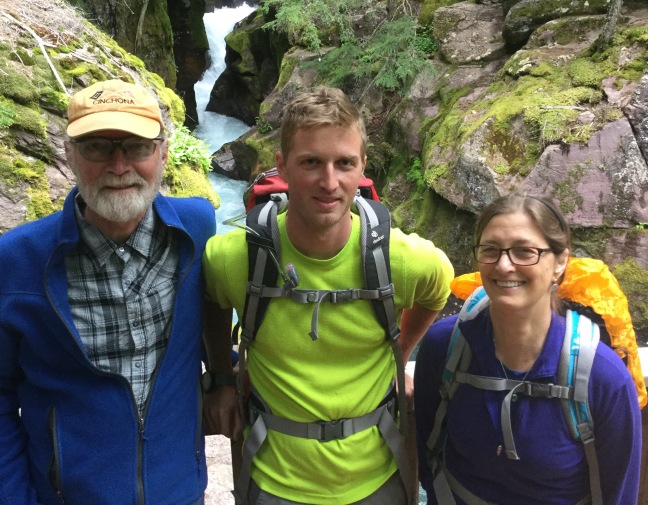
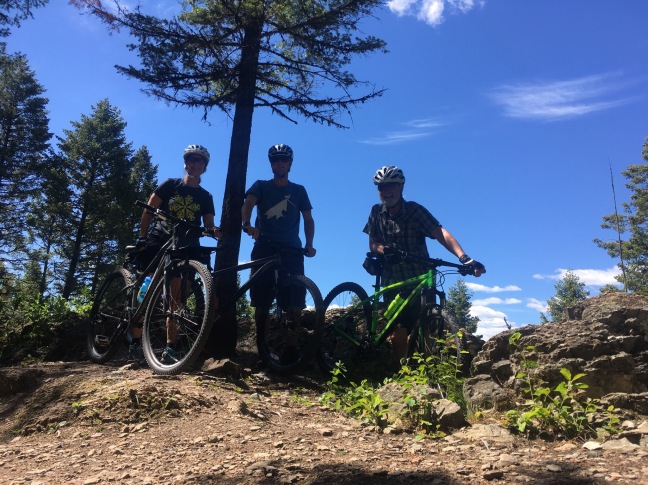
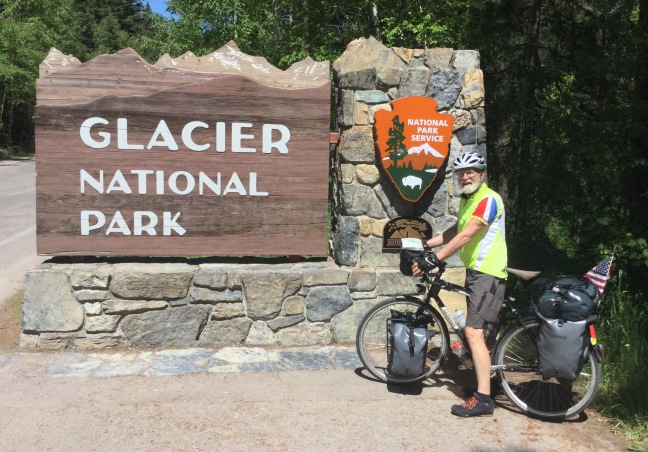
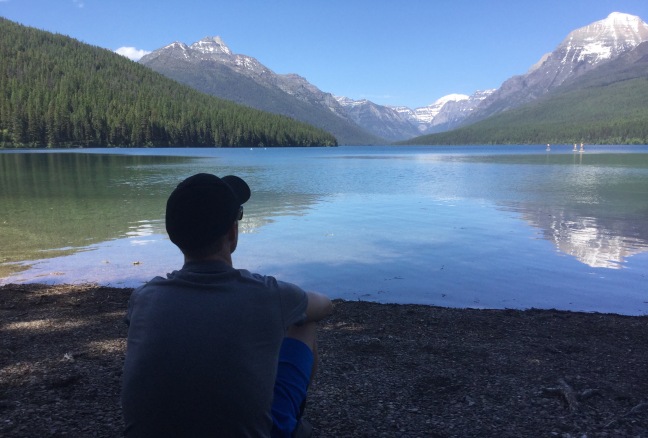
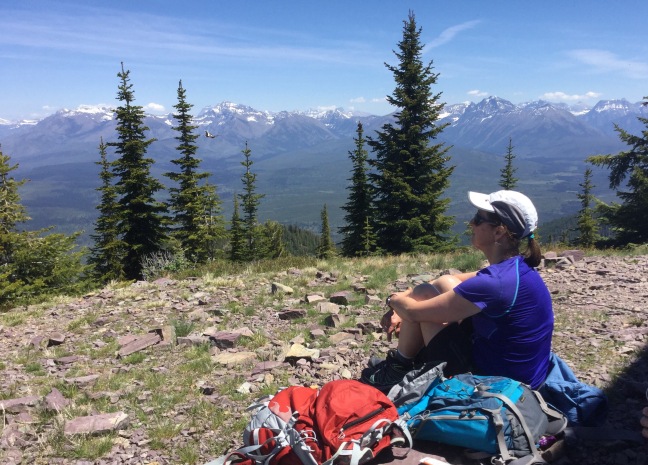
Mary Sue and Nick arrived late on June 1st after a 10-hour drive from Seattle.  It is SO good to see them and to have company for a week.  We have been exploring the west side of Glacier National Park and adjacent Whitefish, including a fun day mountain biking back at the Bike Retreat and hiking into Avalanche Lake, Huckleberry Lookout and along Bowman Lake.  National Parks are supposed to protect jaw-dropping scenery as well as significant ecosystems, and Glacier N.P. does not disappoint. The size of this place is incredible, the mountains huge, the range long, the valleys enormous, the vistas unbelievably awesome.  I am beginning to appreciate why Montanans’ use the word BIG to describe much of their state and its attractions.

image

(It’s great to have company: Nick and Mary Sue join me in Glacier N.P., 6/2/2016)


image

(A “rest” day with fam: mountain biking on the Whitefish Trail, 6/3/2016)


image

(Moving from Whitefish into the west side of Glacier N.P., 6/4/2016)


image

(Nick contemplating the view of Bowman Lake in Glacier N.P., 6/4/2016)


image

(Mary Sue enjoying the swallowtail butterfly from Huckleberry Lookout in Glacier N.P., 6/5/2016)


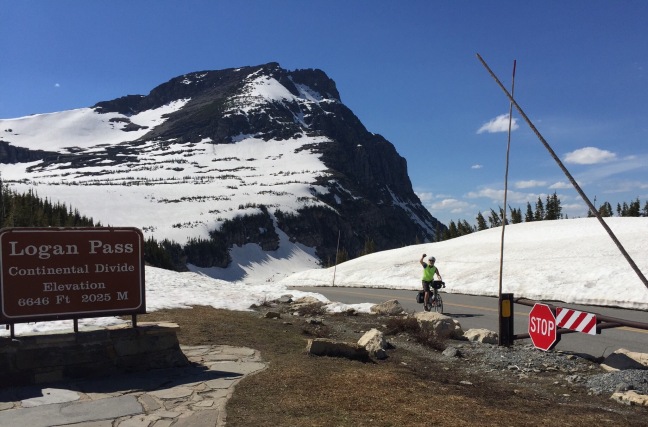
This is both a chance for me to relax off the bike for a few days and a chance to visit with Mary Sue and Nick.  I have also been waiting patiently for Going to the Sun Road to open up-and-over 6600-foot Logan Pass, the high point, so to speak, of this entire cross-country adventure.  Snow-clearing is still underway on the east side of the Pass, so the cross-mountain route stays closed.

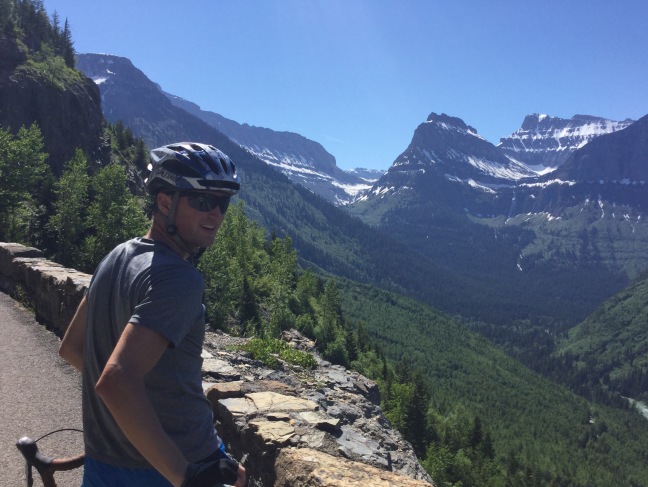
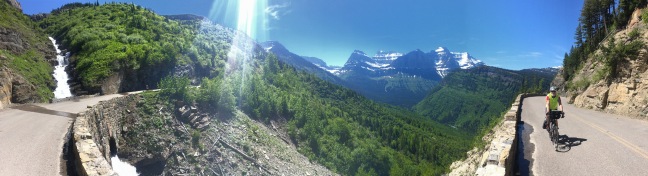
As a result, I moved to option B (as recommended by cyclist Holden Hughart, whom I met in Colville more than a week ago).  With the Going to the Sun Road closed to traffic but open to bicyclists on the west side, it turned out to be the perfect decision. All three of us rode this unbelievable route sans traffic, to Logan Pass and back to Lake McDonald, on what for all of us was the most stunning as well as challenging ride of our lives.

image

image

image

image

image

The ride back down was spectacular and fast — grinning from ear to ear, coasting at 30 miles-per-hour and savoring the payoff after the long climb up.  This day is one of those penultimate experiences that we’ll remember forever.  What a treat for me to share it with Mary Sue and Nick (we missed you, Veronica!).

The Seattle contingent has to head west tomorrow, as I circle around to the south of the park over Marias Pass (only 5200 feet!), leave the mountains behind me and begin the long stretch east across the high plains.

— Dave (posted 6/7/2016 from Apgar MT)

Idaho and NW Montana – wide open country

Wow, is this a beautiful – and remote – part of the country or what?  The vistas, the forests, the lakes, the rivers, the deer (and moose!), the empty roads, and, oh, did I forget, the mountains — what an awesome part of God’s country.  And the people — friendly as all get-out, welcoming, incredulous (and supportive) of my trip.

I spent less than 48 hours crossing the panhandle of Idaho.  I passed by the shores of the Pend Oreille River and Lake Pend Oreille, and spent a night in Sandpoint where I got a new chain at the Greasy Fingers Bike Shop and great coffee at Evans Brothers near the old grain tower.  I can see why people rave about this place — the views in every direction are awesome.

After a morning cycling around the north end of this beautiful lake, I passed through Clark Fork and entered Montana just like that.  Two states down, 14 to go.

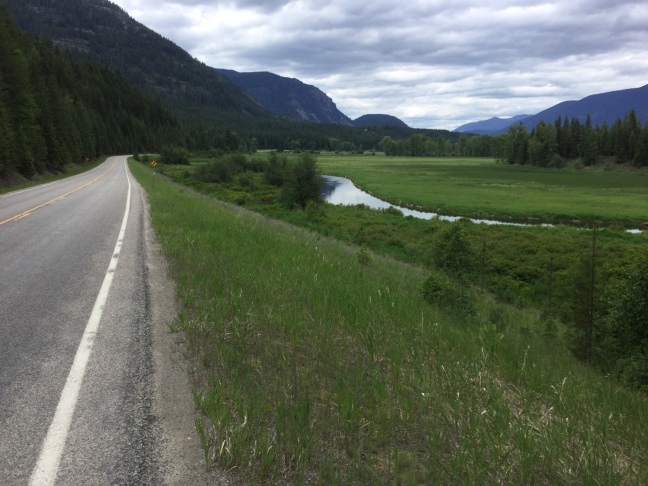
Almost immediately the immensity of this state presented itself.  Talk about wide open spaces, untraveled roads, enormous vistas, big sky.  I get it now.  Montana is one BIG place.  And I’ve just scratched the surface.image

I had a wonderful cycle up the Bull River Valley, with views of the Cabinet Range peaks, and stopped at the Halfway House on route 56 near Bull Lake.  This is a bar, restaurant, and center-of-action for this valley. It was Saturday night of Memorial Day Weekend, and the locals invited me to camp behind the tavern —  “live band tonight!”  Folks came out of the woods as well as the woodwork — I had no idea so many locals existed in this remote valley.  I was welcomed and included, captured by three 7-8 year old girls who took me under their wings.  This was an extended family who live nearby, collect morels, drive 4-wheel ATVs, and probably have a very different view of the political world.  Yet that never came up — they were so hospitable and friendly, it was a wonderful experience to include them in my world and me in theirs.  Nice folks, close to the earth, good with their kids and loving this remote, rural life.  The sense of family and community was deep.image

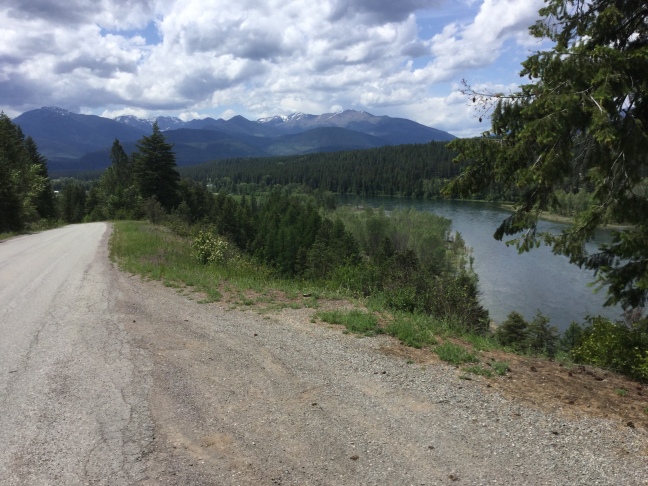
I rode through Libby, Montana (site of the notorious WR Grace vermiculite mines and a town that had one of the highest asbestosis death rates in the world, but sleepy and well-kept today).  Upstream, I rode by the Libby Dam (operated by the U.S. Army Corps of Engineers), an enormous dam on the Kootanai River that is part of the larger Columbia River system; the lake it creates behind it floods well up into Canada.  I camped on this lake (Koocanusa) and rode along its remote shores for many miles through beautiful forests and quiet roads.image

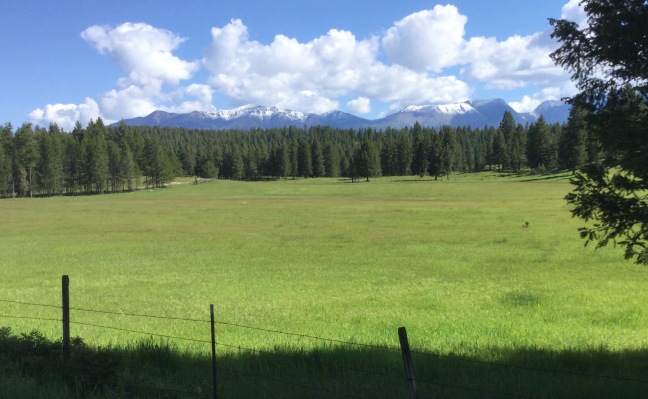
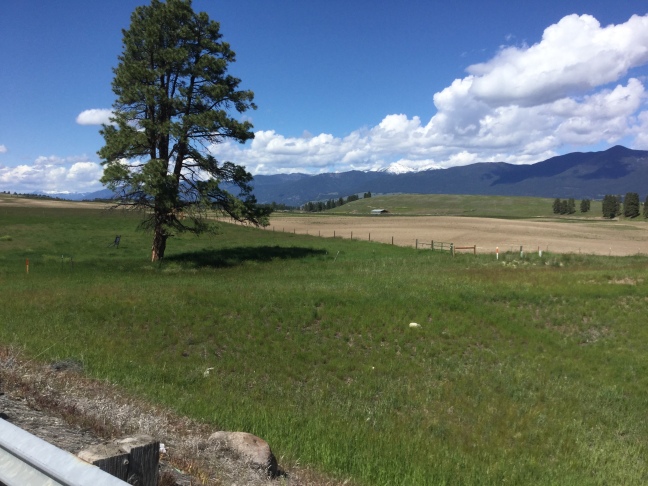
I turned a corner after Rexford, MT, and suddenly came out into an agricultural valley with views of the Rockies from Banff to Glacier.  What an extraordinary spot, within 5 miles of the Canadian border.image

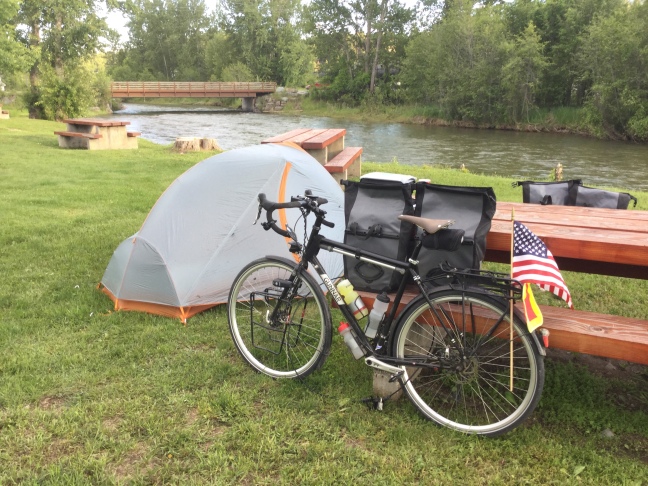
I camped the night at a town park in Eureka, MT, and spoke with a couple who live in the town.  They agreed with my assessment of its beauty, and said they loved it so much they’d never leave the area.  I can see why.image.jpeg

Onward tomorrow to Whitefish, MT, where I’ll meet Mary Sue and son, Nick, who are coming in on Wednesday.  It’ll be so nice to spend some time with them and chill a few days from the focus on my ride.  After that… Up over Going to the Sun Road in Glacier National Park, and onward East!

— Dave

Eastern Washington

I know I’ve left the coast and entered the Inland West when I see Ponderosa Pines, hear Western Meadowlarks, see Chicken Fried Steak on menus and am called “Honey” by the woman behind the diner’s counter.

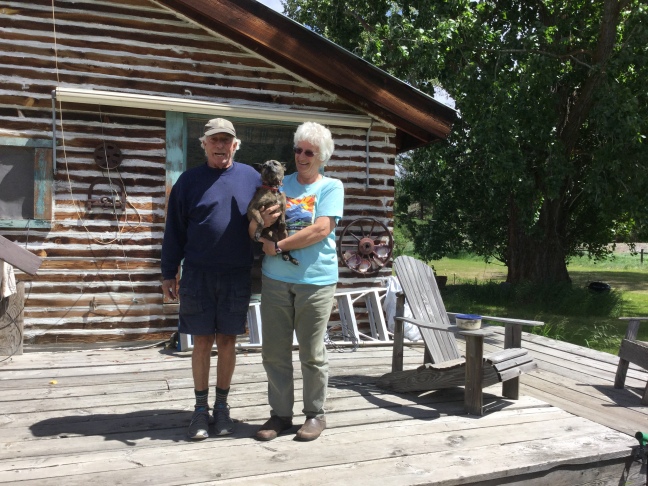
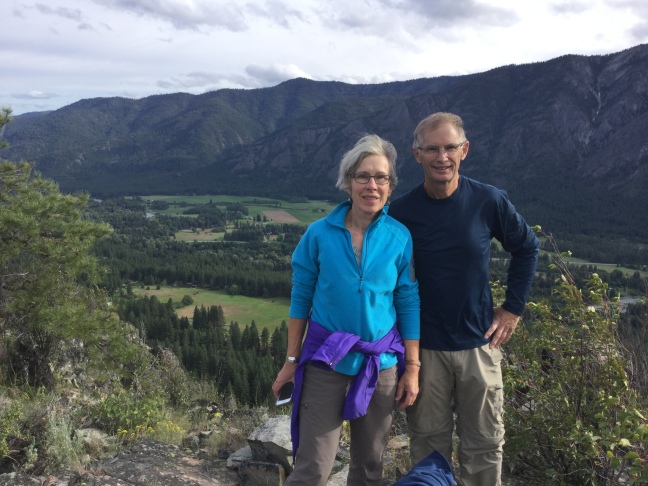
After enjoying a wonderful rest day with Lucy Reid and Bernie Bernheisel down the Methow Valley, more angels appeared in the form of former colleague, Steve Oien, and his wife, Hanne, who invited me to stay with them at their place just south of Mazama.  A hike up to a spectacular valley view just above their place, plus good food and conversation, made for an unexpected treat that night.image

(Bernie and Lucy at Bernie’s place on the Methow River in Carlton, WA)

image

(Hanne and Steve on the ridge above their place near Mazama)

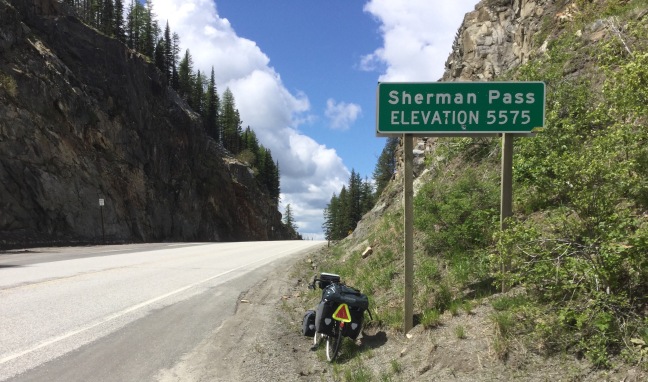
The next three days centered around climbing mountain passes.  In my trip planning I had glossed over how mountainous the Northeast corner of Washington state is — I rode over Loop Loop Pass (4000 ft.) to the Okanogan Valley, then over Wauconda Pass (4300 ft.) to Republic, then over Sherman Pass (5600 ft.) to Colville in three consecutive days.  Relentless seven-percent grades are a good workout when fully loaded down with cross-country gear!image

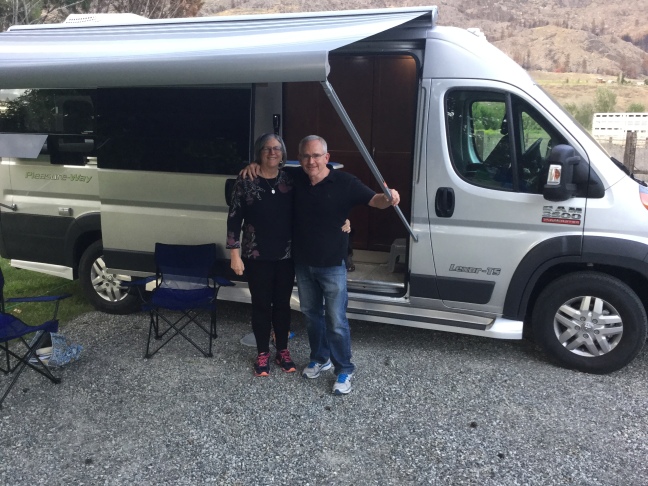
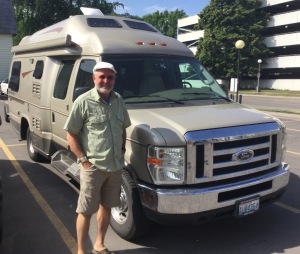
More angels appeared in the Okanogan Valley where former neighbors Jeannie and Jack Spurlock met me at a tiny RV site in Riverside, WA.  They were testing out their new, luxurious camper-van, which they plan to take to Alaska this summer, and plied me with beer and dinner after my 74-mile Loop Loop day as well as coffee and eggs the next morning to get me going on my way through Tonasket and over Wauconda Pass.  It was a treat to see these friends in such an out-of-the-way place.image

(Jeannie and Jack on their maiden voyage with a fancy new camper-van)

And yet another, completely unknown road angel appeared in downtown Republic as I sat by the curb trying to assess my camping options for the night.  A car stopped and the driver asked, “Are you doing the Northern Tier (bike route)?  Want to stay in my yurt?”  The kindness of strangers is an awesome thing!

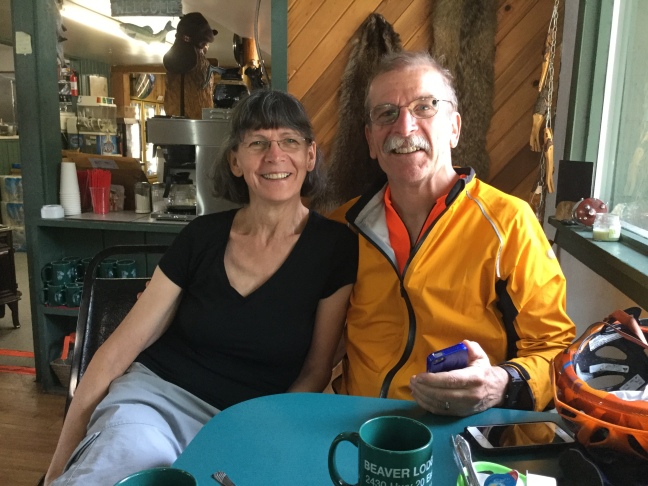
In Colville I ran into a couple from Portland, OR — Holden and Helene Hughart.  Holden is doing the same ride as I am, after retiring at the end of last year.  He started in Neah Bay well after me and is making double-time in part because Helene is serving as his sag wagon and thus he doesn’t have to carry a full load on his bike (plus he looked to be in much better bicycling shape!).  Nice people.  It was fun for me to ride for half a day with Holden, chatting all the way, after all my solo days to date — he was nice enough to ride at my pace.  By today he is already well ahead of me and will finish at Quoddy Head lighthouse in Maine before the end of July.image.jpeg

(Helene and Holden at the Beaver Lodge Cafe between Colville and Ione, WA)

Coming out of Colville yesterday, as I was looking at my map searching for a work-around to a detour, a worker asked, “Where you headed?”  “Maine,” I replied.  “Is this the right direction?”  “NO,” he retorted, “the airport is back that way!”  After much laughter and good conversation, he wished me Godspeed.

I had my first 90+ mile day from Colville to Newport, which is right on the Idaho border.  Unfortunately this otherwise lovely day was marred by FOUR dog attacks along a ten-mile stretch of road through the Kalispell Indian Reservation.  Loose dogs are a hazard peddling on rural roads, but this was a bit much.  If it weren’t for the pepper spray that I carry right on my handlebars, I might have spent last night in the Spokane emergency room.

This remote corner of Washington state has a different culture from Puget Sound, for sure.  I have overheard conversations in the diners expressing enthusiasm for Trump, dissecting Hillary’s emails, and discussing where the militias will meet to resist the urban hoards when the nuclear bombs hit.  Seriously.  Yet despite the extreme politics, people are friendly and I get many more waves from passing rigs than the few who don’t give me an inch on the road.  People I talk with are uniformly encouraging, even enthusiastic, when they hear about my trip.  Such encounters renew my faith in America and the generosity of Americans regardless of stripe.

image.jpeg

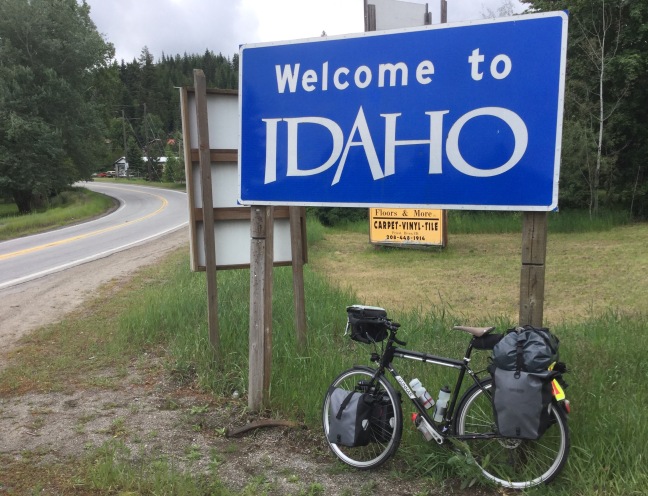
I entered Idaho this morning.  One state down, 15 to go!  Thanks for your interest and your positive thoughts.  I hope you are enjoying the postcards from rural America in my photo gallery — we sure do have a beautiful country out here.

— Dave (posted from Sandpoint, Idaho)

From the Pacific over the Cascades


image

What an amazing first week!  350 miles into the trip, from salt water to dry Eastern Washington farmland over the North Cascades.  Tail winds most of the week, great weather until the heavy lift over the mountains on a cold, wet day 7.

My ride across the top of the Olympic Peninsula was lovely after my first-day trial with the rigs on highway 112. I found portions of the Olympic Discovery (bike) Trail which were quite wonderful – quiet, off-road, just me and the birds singing – a real gem for bicyclists in this area.  I swept through Port Angeles along the waterfront, and through Port Townsend where I had a nice lunch visit with former co-worker Cindi Alberti before catching the short ferry ride across Admiralty Inlet to Whidbey Island.  I enjoyed a relaxing rest day with Baz Stevens in Freeland, including a visit from Mary Sue who came up after work from Seattle.

Then my route took me up Whidbey (including getting strafed by Naval Air Station Growlers – EA-18G, carrier-based jets); over the always-impressive Deception Pass Bridge; then across the Skagit Flats and up valley into the edge of the Cascade Mountains.  Giant steelheads lurked under the bridge over the Cascade River.  The guy at the cash register in Marblemount General Store asked, “So where are you headed?” “Maine.” He gazed into space over my shoulder with a look as if to say, “The loonies are back,” and sighed, “I guess it’s that time of year again.” (I’m now officially on the “Northern Tier” cross-country bike route as mapped by the Adventure Cycling Association — this guy must see his share of us loonies as we head east!  I am one of the first of the season.)

image.jpeg

After a wet night at Colonial Creek campground on Diablo Lake in the North Cascades National Park, I had my first really challenging day as I rode in the cold rain up and over the Cascade Mountains.  As I slogged uphill going a robust 4 miles-per-hour in low gear, an SUV stopped ahead of me and out popped Lisa Niehaus, a former co-worker on her way to Winthrop for the weekend.  What an unexpected  treat!  The ride was a relentless 31-mile, 6.5 hour climb to Washington Pass at 5477 feet above sea level — my first major milestone, snow still deep by the sides of the road.  The following 18-mile downhill was a bit scary until I got more comfortable at speed with all the weight I’m carrying, on wet pavement, plus so cold that I was hypothermic by the time I reached the Mazama Country Store.  Three cups of hot coffee to wrap my hands around eventually warmed me back up.

Since Kim and Steve at North Cascades Basecamp are swamped launching a new field course this weekend, houseboat neighbor Lucy Reid and her friend Lee “Bernie” Bernheisel, who both have houses in Carlton in the Methow Valley, appeared on a moment’s notice like angels to sweep me up, give me a roof, bed, hot shower, soup and great conversation!  Angels indeed.  I’m enjoying a restful day off at Bernie’s place right on the Methow River, drying out my gear, doing laundry and listening to the birds singing outside.

Speaking of birds, I’ve started a list which I post on a separate page.  All the way from Neah Bay to the Cascades I have been serenaded daily by Black-headed Grosbeaks and Western Tanagers along with many other varieties.  I’m paying attention to what I see and hear from my handlebars as I peddle along.  List to date in close to 70 species!  It was fun late yesterday to hear my first meadowlark, a sure signal that I’ve left the coast and crossed into the Inland Empire.  No more salt water for a long while.

The old body seems to be holding up so far, with one rest day in the first seven and 350  miles under my belt.  I must admit that yesterday’s long, cold, wet climb over the mountains was the hardest day I’ve ever spent on a bike.  It was with joy and a few exhausted tears that I stopped to celebrate having achieved the high pass.

image


My friend Baz says that I need to articulate WHY I am doing this ride.  I wondered, sometimes aloud, about this as I slogged over the mountains yesterday.  I’ll write my thoughts in a separate page.  But I do want to close with a note of appreciation for all my friends near and far who are watching over me, worrying more than I am about my daily challenges, and supporting my ride through postive thoughts.  I’ve already had many moments where suddenly things have gone right — I’ve thanked my mom Rita many times for helping me out from above, and I expect that your positive thoughts are involved too.  Thank you.  Even on a solo adventure, I’m close to so many kind souls that I feel blessed.

Onward to the east.  Next major challenge:  the Rockies in about ten days.

— Dave

P.S.  I’ll continue to post more photos on a separate page (“Photo Gallery”).  In addition, I am trying to post daily maps (“Where’s Dave?”) so, if interested, you can check in between blog posts to see where I am.

Launched


image

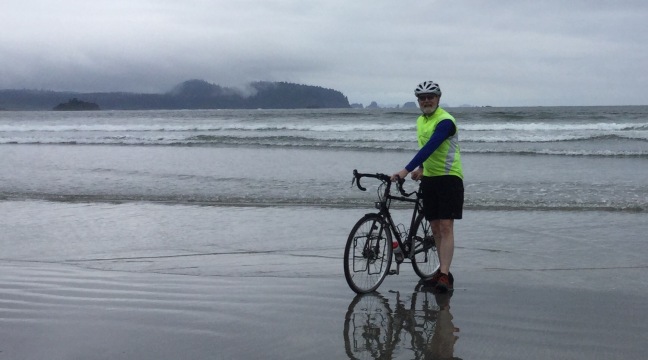
My odyssey began today, finally after all the planning and anticipation.  I’m now sitting at Crescent Beach on the Strait of Juan De Fuca after peddling 62 difficult miles, eating the best smoked salmon on the planet along with Fritos, for starters; full dehydrated meal to follow as I try to replenish the 3000+ calories I burned. I’m off the vegan wagon on this trip!

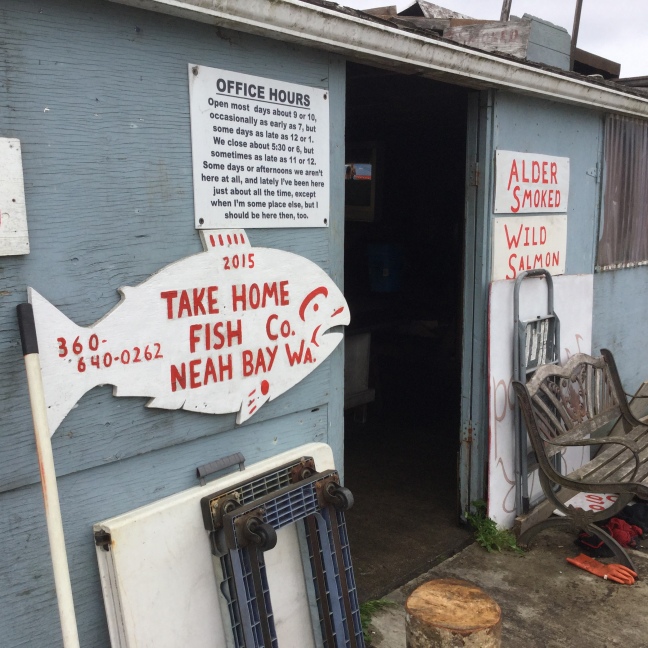
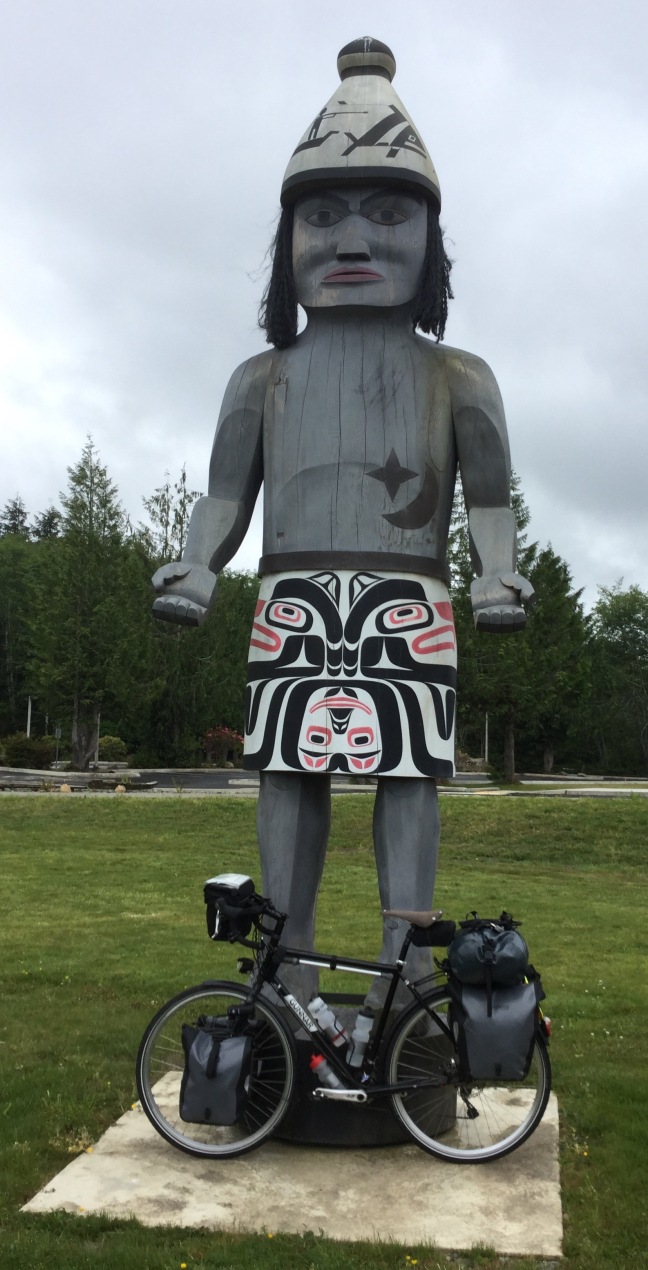
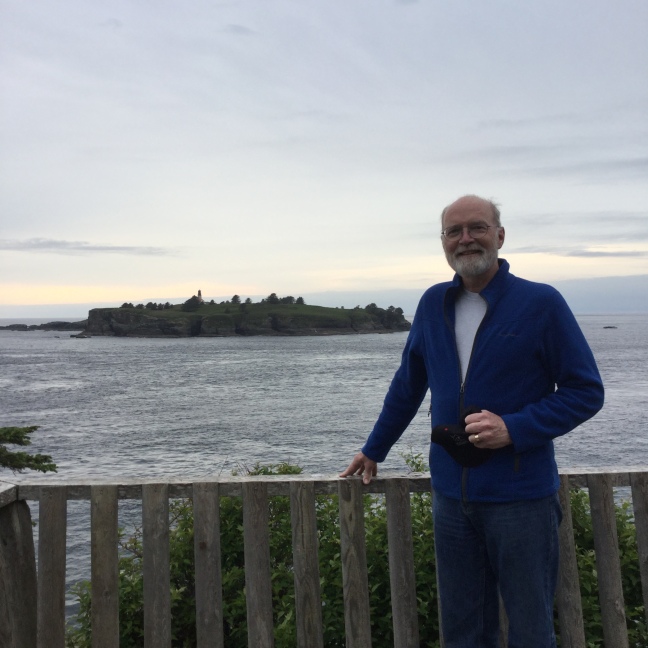
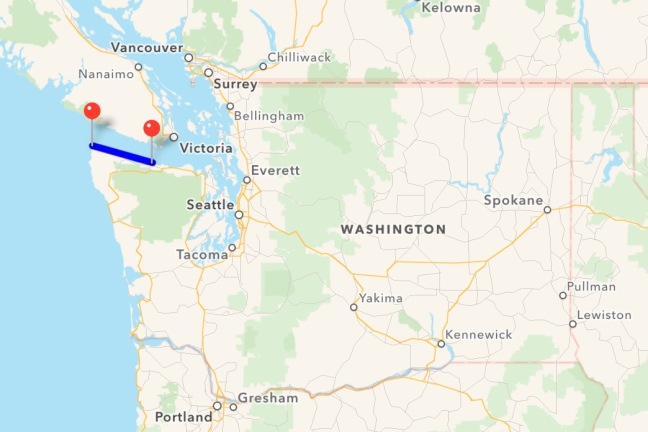
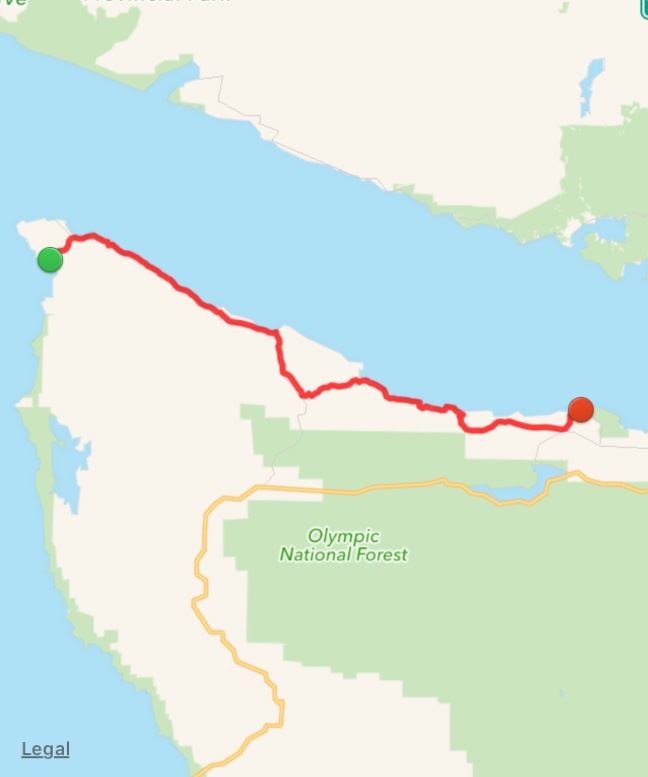
To back up, Mary Sue drove out to Neah Bay with me yesterday.  We camped at Hobuck Beach where the Pacific Ocean’s waves thunder ashore.  We hiked out to Cape Flattery, at the edge of the continent, the farthest one can go in the Northwest corner of the lower 48 states, and looked across to the lighthouse on Tatoosh Island. We visited the Makah Tribe’s Museum, which houses an amazing collection of wooden, ocean-going canoes, whale bones and artifacts from the famous Ozette excavation site.  We also bought smoked salmon from our favorite Makah place,  Take Home Fish Co.

It rained most of the night, and I kept waking up thinking, “How fitting for my first day to get soaking wet here in the Northwest.”  But the gods were with me as the day was cool, overcast with only scattered light rain, actually good weather to bike in.

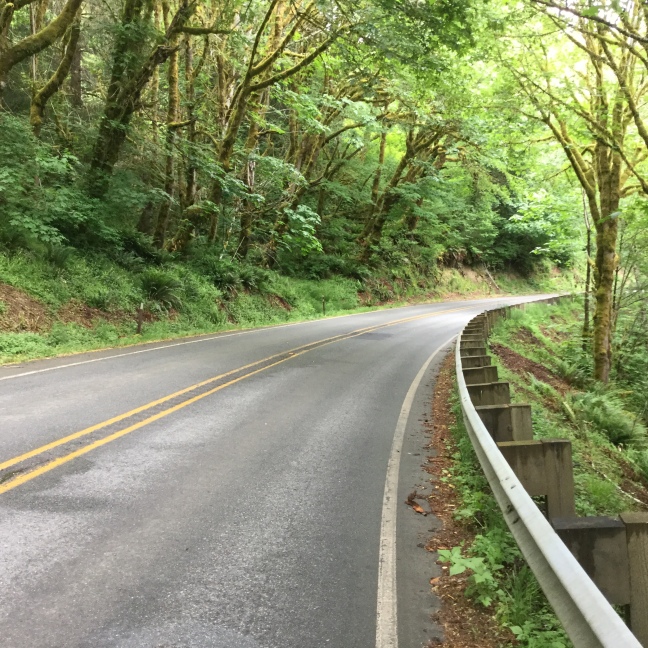
Yesterday was opening day for the halibut fishing season, so usually-sleepy Neah Bay was packed with guys and their gear, rigs pulling enormous boats.  The downside for me was that most of these rigs pulling gigantic boats left on the little curvy road out of Neah Bay today, and I spent most of the day trying hard to not get knocked off the narrow, winding road with no shoulder.  This is actually a very dangerous road to bicycle on — I wouldn’t recommend it for others.  But I survived.

I stopped at a nice diner in Sekui after a couple hours riding and had a gi-normous eggs-and-hash-browns breakfast.  I hope to repeat this pattern all along the trip!

For my first day, on a difficult stretch of road and weighed down by a lot of gear, I felt that the first 62 miles of this voyage were hard earned.  I’ll sleep well tonight.

— Dave

image

image

image

image

image

image

image


My Kit

As I prepare to launch this adventure, I’m focused on what I need to bring, and what I need to leave behind. Hard choices, indeed. Even with the hard choices, I feel like I’m bringing way too much. I expect I will end up shipping some of this stuff home after getting tired carrying it. But for now, here is my starting-out list:

Bike Stuff:

  • helmet (Giro – serial # Y7632452)
  • Road I.D. bracelet
    (in case of an accident, it lists my name and contact numbers for Mary Sue, Nick and Veronica as well as my health insurance number)
  • tire pump
  • extra tubes (2)
  • tire change irons (3)
  • puncture seals for tubes
  • all-in-one tool kit (Allen wrenches, screw drivers, spoke wrench,  etc.)
  • crescent wrench and cassette nut
  • FlashStand (Topeak brand – alternative to a kick-stand that attaches onto crank arm)
  • replacement spokes (4)
  • no extra tire or extra chain (I’ll be riding through towns with bike shops, so if I need replacements, I’ll be able to find them — I hope!)

Bike Clothing:

  • bike jersey long sleeve (1)
  • bike jersey short sleeve (2)
  • bike shorts with padding (2)
  • bike socks (2)
  • bright yellow safety vest
  • bike jacket (water proof)
  • rain pants
  • rain booties (to pull over shoes)
  • bandannas for under helmet (2)
  • bike gloves (padded) (2)

Off-bike Clothing:

  • long pants (1)
  • shorts (1)
  • down jacket
  • underwear briefs (2)
  • long underwear, top and bottom
  • light-weight walking shoes
  • socks for off-bike (2

Camping Gear:

  • tent (REI quarter dome 2) (3 lbs. 9 oz..)
  • tent footprint ( ” ) (9 oz..)
  • sleeping bag (Kelty Cosmic DriDown 550fill, 41 degrees F.) (1 lb. 14 oz..)
  • pad (ThermaRest Evolite) (1 lb. 7 oz..)
  • pillow (SeaToSummit Aeros Premium) (3.7 oz.)
  • sleeping bag liner (Cocoon Coolmax travel sheet) (11 oz..)
  • lights (MPowerd Luci inflatable solar lanterns – 2) (4.4 oz..)
  • headlamp (Ptezl Tikka Plus)
  • stove (JetBoil MiniMo) (14 oz..)
  • gas cans for stove (2 @8 oz.)
  • bowl, cup, knife/fork/spoon
  • bug head net (Ben’s InvisiNet) (0.7 oz.)

Tech:

  • iPad (Air 2 with Logitech keyboard case)
  • iPhone
  • Dynamo with USB port (built into bike)
  • Solar charger …
  • external battery pack (RAV Power Deluxe, 16750 mAh)

Personal:

  • hygiene (tooth brush, toothpaste, razor, nail clippers, etc.)
  • sun screen
  • toilet paper and trowel
  • a few first aide supplies (band-aids, etc.)
  • extra pair of glasses